
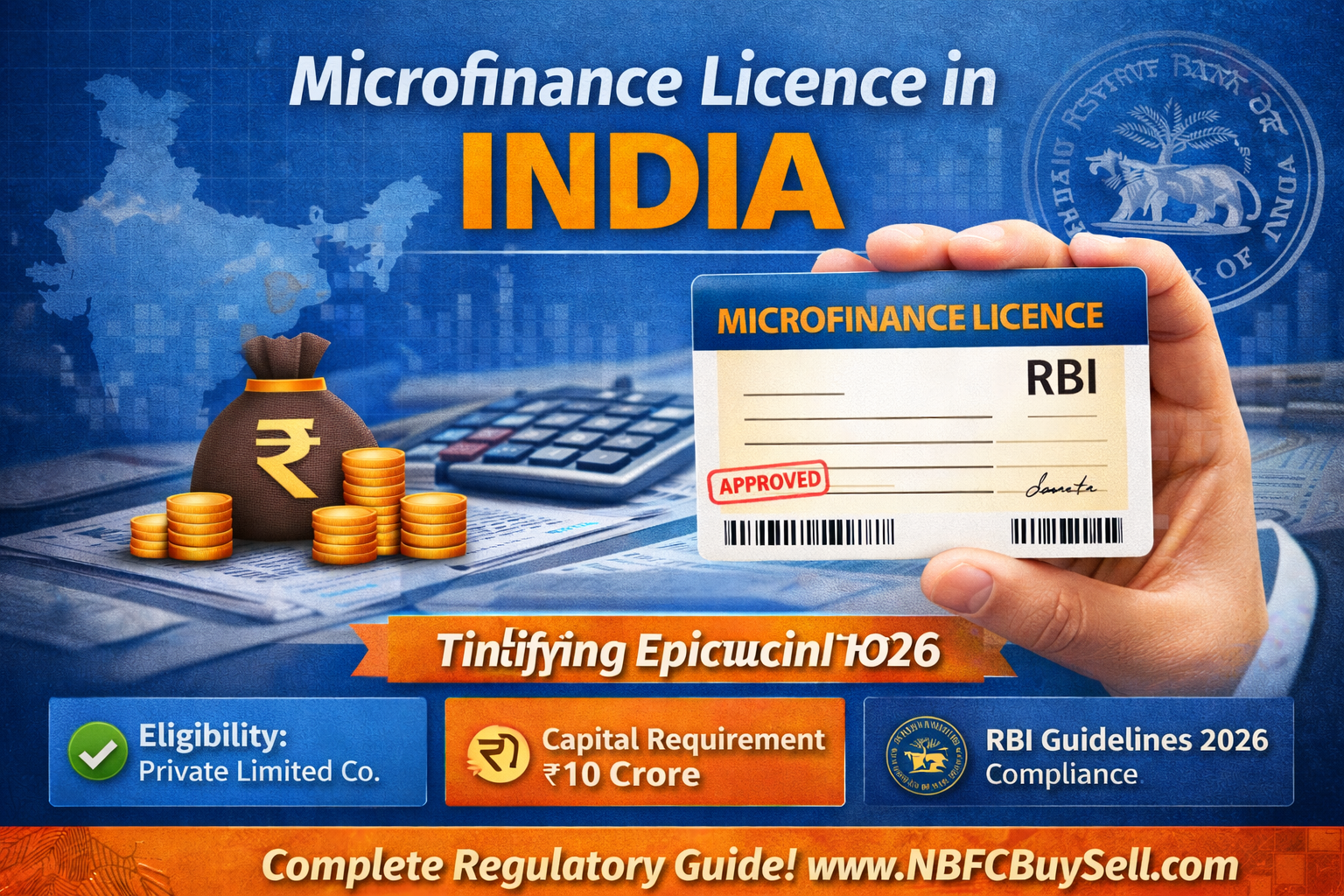
Microfinance Licence in India – Complete Legal & RBI Guide (2026)
A microfinance licence in India is required if you want to legally operate a large-scale microfinance institution (MFI) under the regulatory framework of the Reserve Bank of India.
Microfinance companies play a crucial role in financial inclusion by providing small loans to low-income borrowers, women entrepreneurs, rural households, and small businesses.
If you are planning to apply for a microfinance licence in India, this article explains the eligibility criteria, capital requirement, RBI approval process, compliance framework, and practical insights.
What is a Microfinance Licence in India?
A microfinance licence is essentially an NBFC registration granted by RBI that allows a company to operate as an NBFC-MFI (Non-Banking Financial Company – Micro Finance Institution).
It authorizes the company to:
- Provide small ticket loans
- Conduct group lending
- Offer rural & priority sector financing
- Raise institutional funding
Without RBI approval, large-scale lending operations are not legally permitted.
Who Regulates Microfinance Companies?
Microfinance companies operating as NBFCs are regulated by the Reserve Bank of India under:
- RBI Act, 1934
- NBFC Master Directions
- Microfinance regulatory guidelines
RBI ensures borrower protection, fair lending practices, and financial stability.
Eligibility Criteria for Microfinance Licence in India
To obtain a microfinance licence in India, the applicant company must:
- Be incorporated as a Private Limited Company
- Have minimum Net Owned Fund (NOF) of ₹10 Crore
- Meet RBI “Fit & Proper” criteria
- Have clean financial track record
- Demonstrate viable business model
For North Eastern states, minimum NOF requirement is ₹5 Crore.
Capital Requirement for Microfinance Licence
The most critical requirement is:
Minimum Net Owned Fund (NOF): ₹10 Crore
This capital must be:
- Fully paid-up equity
- Properly sourced and documented
- Free from encumbrances
RBI carefully checks the source of funds to prevent money laundering risks.
Legal Structure for Microfinance Company
A microfinance company must be incorporated under the Companies Act, 2013 as:
- Private Limited Company (recommended)
- Public Limited Company
Societies and trusts can operate at small scale but cannot function as NBFC-MFI without RBI licence.
Process to Obtain Microfinance Licence in India
1️. Company Incorporation
- Draft proper object clause
- Appoint directors with financial background
- Maintain clean CIBIL record
2️. Capital Infusion
- Deposit minimum ₹10 Crore
- Obtain CA certificate for Net Owned Fund
- Arrange banker confirmation
3️. Documentation Preparation
Important documents include:
- Detailed business plan (5 years)
- Financial projections
- Director KYC
- Net worth certificates
- Board resolution
- Organizational structure chart
Strong documentation significantly improves approval chances.
4️. Online Application to RBI
Application is submitted through RBI’s COSMOS portal.
After submission:
- Physical documents sent to RBI
- Background verification
- Clarification rounds (if required)
5️. RBI Approval
If RBI is satisfied:
- Certificate of Registration (CoR) is issued
- Company can commence NBFC-MFI operations
Timeline for Microfinance Licence Approval
Approval generally takes:
6 to 12 months
Timeline depends on:
- Documentation quality
- Promoter credibility
- RBI workload
Professional structuring reduces delay.
RBI Compliance After Getting Microfinance Licence
Once licensed, company must comply with:
- Fair Practices Code
- KYC & AML norms
- Reporting requirements
- Prudential norms
- Interest rate regulations
Non-compliance may lead to heavy penalties or cancellation.
Common Mistakes in Microfinance Licence Application
- Weak promoter profile
- Unclear capital source
- Poor financial projections
- Inadequate compliance planning
- Improper object clause drafting
FAQs – Microfinance Licence in India
Is RBI registration mandatory for microfinance?
Yes, for NBFC-MFI operations at scale.
What is minimum capital required?
₹10 Crore (₹5 Crore for NE states).
Can foreign investors invest?
Yes, subject to FEMA & FDI guidelines.
How long does approval take?
Typically 6–12 months.