
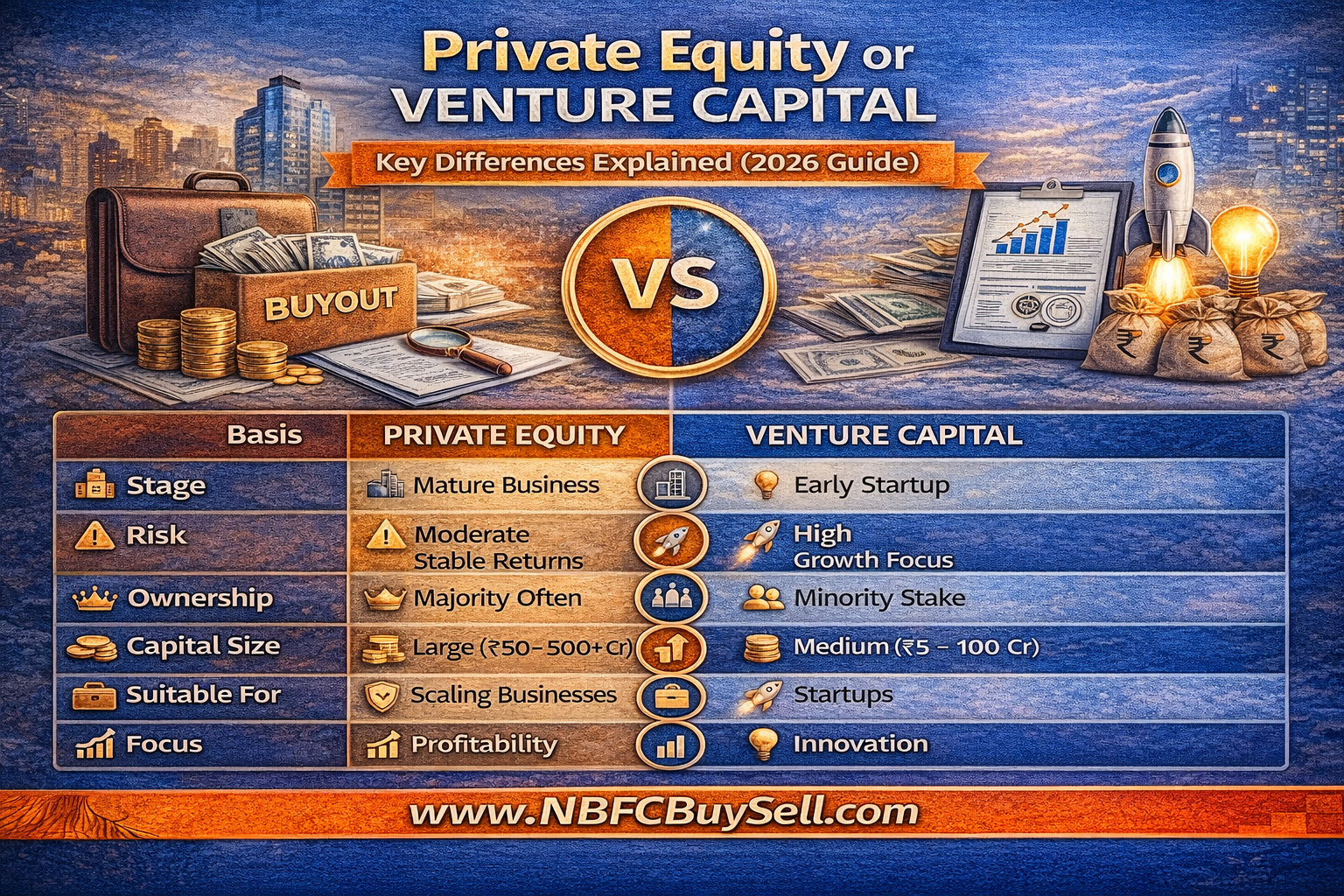
Private Equity or Venture Capital Key Differences, Funding Stages
If you are a startup founder, fintech entrepreneur, or business owner planning to raise capital, one critical question arises:
Private Equity or Venture Capital – which is the right funding option?
Both funding models provide capital, but they differ significantly in:
- Investment stage
- Risk profile
- Ownership structure
- Control rights
- Exit strategy
- Expected returns
Understanding the difference between private equity and venture capital helps businesses choose the right funding partner based on growth stage and long-term objectives.
What is Venture Capital?
Venture Capital (VC) is funding provided to early-stage startups that show high growth potential but may not yet be profitable.
Venture capital firms typically:
- Invest in seed to Series A/B rounds
- Take minority equity stake
- Accept high risk
- Expect exponential growth
- Provide strategic mentorship
VC is common in:
- Fintech
- SaaS
- AI startups
- E-commerce
- Digital platforms
What is Private Equity?
Private Equity (PE) refers to investments made in mature, revenue-generating businesses.
Private equity firms:
- Invest in established companies
- Often take majority or controlling stake
- Focus on operational improvements
- Aim for structured growth
- Target predictable returns
PE investors usually enter at:
- Expansion stage
- Pre-IPO stage
Buyout stage
Private Equity or Venture Capital – Detailed Comparison
1️⃣ Stage of Investment
Venture Capital:
- Early-stage startups
- Pre-revenue or early revenue stage
- Product-market fit phase
Private Equity:
- Growth-stage companies
- Established revenue streams
- Profitable or near-profit businesses
👉 If you are an early startup → VC
👉 If you are scaling → PE
2️⃣ Risk & Return Profile
Venture Capital:
- High risk
- High return potential
- Many investments fail
Private Equity:
- Lower relative risk
- Structured returns
- Focus on financial discipline
VC bets on innovation.
PE bets on stability.
3️⃣ Ownership & Control
Venture Capital:
- Minority stake
- Limited board control
- Founder retains majority influence
Private Equity:
- Often majority stake
- Strong governance rights
- Operational intervention common
If maintaining control is important, VC may be better.
4️⃣ Investment Size
Venture Capital:
- Smaller ticket initially
- ₹5 Crore – ₹100 Crore (varies by stage)
Private Equity:
- Large investments
- ₹50 Crore – ₹500+ Crore
PE deals are usually much larger.
5️⃣ Involvement in Business
Venture Capital:
- Strategic mentorship
- Network support
- Scaling guidance
Private Equity:
- Operational restructuring
- Cost optimization
- Leadership changes possible
PE firms are often more hands-on.
6️⃣ Exit Strategy
Both PE and VC investors exit through:
- IPO
- Strategic acquisition
- Secondary sale
However:
VC exits are growth-driven.
PE exits are valuation-optimization driven.
Comparison Table – Private Equity vs Venture Capital
|
Basis |
Venture Capital |
Private Equity |
|
Stage |
Early |
Mature |
|
Risk |
High |
Moderate |
|
Control |
Minority |
Majority Often |
|
Capital Size |
Medium |
Large |
|
Suitable For |
Startups |
Scaling Businesses |
|
Focus |
Growth |
Profitability |
Private Equity or Venture Capital – Which is Better?
There is no universal answer. It depends on:
Choose Venture Capital If:
- You are an early-stage startup
- You need strategic mentorship
- You prioritize rapid growth
- You are not yet profitable
Choose Private Equity If:
- Your business is stable
- You need large expansion capital
- You are planning IPO
You are open to external control
Funding Strategy for NBFCs & Fintech Companies
NBFCs and fintech companies often raise:
- Venture Capital in early licensing stage
- Private Equity during expansion phase
However, funding in regulated sectors requires:
- RBI compliance
- Shareholding structure planning
- Fit & Proper criteria checks
- FDI compliance
Proper structuring before raising funds is essential.
Common Mistakes While Choosing Between PE & VC
- Choosing PE too early
- Giving excessive equity
- Ignoring control clauses
- Not understanding exit rights
- Ignoring regulatory compliance
Professional advisory is recommended before signing term sheets.
FAQs – Private Equity or Venture Capital
Is venture capital only for startups?
Yes, primarily early-stage companies.
Do private equity firms take control?
Often yes, especially in majority investments.
Which funding gives higher valuation?
VC may offer higher valuation at early stages.
Can NBFCs raise venture capital?
Yes, subject to RBI and regulatory compliance.